-
Because the Jews for religious purpose used ash in The Temple
by the priests, and later by Judaism and the Pharisees, it would
be both relevant and timely, and in light of Roman Catholicism,
critical to expose!
Many of the central reasons it is wrong have already been proven
for centuries such as
1. Ash Wednesday, like Infant Baptism was derived from and copied
from Baal Worship paganism.
2. Unlike Communion it found nowhere in Scripture or commanded
for the Church.
3. It is tradition of man vs tradition of Christ and His Apostles.
4. It disobeys Christ's command that fasting should be personal
and private, not a public show and parade.
5. The T shape of ashes on the forehead is historically not the
Cross, T as in Tamuz, though most believe it is the Cross.
I agree with all of these points. Now, I would like to present
to you what I didn't find anywhere in my research, but what I
believe the Holy Spirit and Scripture revealed to me:
"
"For if the blood of goats and bulls and the ashes of a
heifer sprinkling those who have been defiled sanctify for the
cleansing of the flesh,?how much more will the blood of Christ,
who through [fn]the eternal Spirit offered Himself without blemish
to God, cleanse [fn]your conscience from dead works to serve
the living God?" Hebrews 9:13-14
Note that ashes do nothing for the soul no matter where you put
them on the body.
2. In order to produce ashes you have to burn the red heifer's
body completely until it becomes ashes, after it has been slain
in sacrifice. So here's the most seismic revelation to me: Jesus
was the Perfect Sacrifice Slain for the Sins of the whole world!
But here's the problem: yes, like heifers and lambs, he was slain.
But Jesus was never burned to produce ashes and not a single
bone in his body was broken. So it is impossible and farcical
to use literal ashes on your forehead to even symbolize Jesus!
Yes ashes symbolize purification, but purification of Christians
is only made possible with Christ's shed Perfect Blood!
3. Catholics only fast 2 of the 40 Days of Lent. Jesus fasted
for the entire 40 Days in the Wilderness.
4. Jesus was tempted by Satan during the 40 Days. Where are any
of the appearances of Satan to Catholics for a millennium and
a half?
5. Ashes are supposedly used for cleansing. But Scripture says:
"If we confess our sins, He is faithful and righteous to
forgive us our sins and to cleanse us from all unrighteousness."
1 John 1:9
So do ashes have anything to do with confessing our sins ?
And that's to God, not a Catholic Priest!
6. Fat Tuesday reminds me of the Apostle Paul's declarations
about the Cretans in Titus who were gluttons and the Philippians
"whose God is their belly." "Their end is destruction."
So this prelude alone would disqualify Ash Wednesday and Lent
before the Lord!
-
- 7. If Jesus had fasted 40 days before
his Crucifixion, there would have been no Last Supper! And there
is no biblical or historical evidence that Jesus did anything
40 Days prior to his Crucifixion. 40 Days is important for a
second reason , but it refers to the time frame between his Crucifixion
and his Ascension!
-
- 8. Ashes of a red heifer remain ashes
and are never resurrected!
-
- 9. Ash Wednesday and Lent is so full
of confusion, conflating events, and contradictions. And you
know who the author of confusion is!
-
- 10. The countdown to Good Friday or
Resurrection Day in Lent isn't 40 sequential days In Lent but
43-44 days to the Good Friday and ends in 46 days on Saturday,
the day before Resurrection Day. And excludes Sundays and Resurrection
Day without which we all remain dead in our trespasses! This
isn't just fuzzy math, but numerology on steroids!
-
- 11. The Babylonians worshipped Tammuz
and wore the T on their foreheads, made with ashes when they
invaded Israel during the Feast of Tammuz in June and July and
destroyed the First Temple in 586 B.C., which began in 597 B.C,
and didn't end there until 582 B.C. (a total of 15 years). But
it didn't end then for the Jews, because they had to witness
it and be subjected to it for their entire Captivity in Babylon
which was 70 years, as prophesied by Jeremiah and recorded in
scripture (2 Chronicles 36:21, Jeremiah 25:11, 29:10). So all
Jews in Israel would have witnessed this billboard on their foreheads
for almost a century!????
- 12. During the Crusades, the soldiers
in armies celebrated Ash Wednesday during their invasion of Israel
and all the Jews would have observed this and these same Roman
soldiers would then round up the Jews, herd them into synagogues,
lock the doors, then burn them to the ground in July of 1099),
the very same time frame month that Babylonians celebrated Tammuz
and destroyed the First Temple on the 10th of Av: Jeremiah 52:12-13.
A coincidence? I don't think so!
And once again, it didn't end there, as the Roman Empire and
the Catholic Church paraded Ash Wednesday before the eyes of
Jews in Israel and globally to the Dispersed Jews to this day!
And no end in sight! So the shape of the T in Tammuz and Cross
on the foreheads (a distinction without a difference) made with
ashes is a great witness to carry out the Great Commission to
win Jews to the Lord Jesus Yeshua as their Messiah? Feb 26, 2026
author: James Sundquist <rock.salt@verizon.net> Feb 26,
2026
-
- Dr. Christian Wei, leader of Underground
Church in China Response to: My Ash Wednesday Decalogue of Decadence
with permission to publish.
-
- Response:
-
- This is a thorough and provocative critique
of Ash Wednesday and the Lenten season. My analysis leans heavily
on a Fundamentalist framework and
Literal (Grammatical-Historical)
Hermeneutics, which
prioritizes the plain sense of Scripture over ecclesiastical
tradition.
From this perspective, the validity of any religious practice
is measured by the "Regulative Principle of Worship"-the
idea that if God did not command it in His Word, it is not required
(and often forbidden) for the Church.
Below is a detailed response to the points, structured through
the lens of Biblical Fundamentalism.
- 1. The Theological Conflict:
Ashes vs. The Blood
This hits on a critical dispensational and typological point
regarding Hebrews 9:13-14.
· The Red Heifer Typology: In the Old Testament,
the ashes of the red heifer were mixed with water for ceremonial
purification of the flesh ($Numbers 19$). As you correctly noted,
this required the sacrifice to be completely consumed by fire.
·
- The Finished Work: Fundamentalist theology emphasizes that Christ
is the fulfillment of these types. Because Christ was the "Lamb
of God" whose body did not see corruption (Psalm 16:10)
and whose bones were not broken (John 19:36), he was not reduced
to ash.
·
- The Sufficiency of Blood: To return to the use of ashes-even symbolically-can
be viewed as a "dead work" (Hebrews 6:1). If the Blood
of Christ provides total cleansing for the conscience, the application
of ash to the skin is, at best, redundant and, at worst, a denial
of the sufficiency of the Cross.
- 2. Tradition of Men vs.
Holy Scripture
From a literalist standpoint, the absence of Ash Wednesday from
the New Testament is the strongest argument against it.
· Sola Scriptura: Fundamentalists argue that the
"traditions of men" (Colossians 2:8) often make the
Word of God of no effect. Since neither Christ nor the Apostles
instituted a 40-day fast involving ashes, it is viewed as an
extra-biblical invention.
·
- The "Tammuz" Connection: Many Fundamentalist scholars (citing works
like Hislop's The Two Babylons) argue that the "T"
mark and the 40-day weeping period have roots in the pagan mourning
for Tammuz (Ezekiel 8:14). While modern historians debate the
direct lineage, the literalist concern remains: why adopt a symbol
that even resembles pagan idolatry?
- 3. The Performance of Piety
(Matthew 6:16-18)
You pointed out a direct contradiction between the practice of
Ash Wednesday and Christ's commands in the Sermon on the Mount:
- "But you, when you fast, anoint
your head and wash your face, so that you do not appear to men
to be fasting..." (Matthew 6:17-18)
A literal interpretation suggests that a public mark (ashes)
specifically intended to signal one's penitence to the world
violates the Lord's instruction for privacy in devotion. From
this view, a "public parade" of humility is a form
of spiritual pride.
4. The "Fuzzy Math"
and Chronological Errors
- Your point about the 40 days is chronologically
significant.
·
- The 40 Days of Jesus: Jesus' fast in the wilderness (Matthew 4) occurred
at the beginning of His ministry, not the end.
· The Gap: There is no scriptural evidence linking
the wilderness fast to the Passion week. By merging these two
distinct events, the Lenten tradition creates a "theological
mashup" that lacks biblical precedent.
· The Count: As you noted, the calendar of Lent
(excluding Sundays) is an ecclesiastical construct designed to
arrive at a specific number, rather than a literal following
of a biblical timeline.
- 5. Confession: Priest vs.
Great High Priest
Your reference to 1 John 1:9 is the cornerstone of the believer's
relationship with God.
- · The Fundamentalist view is
that the "veil was rent." We have direct access to
the Throne of Grace.
· Requiring a priest to administer ashes or mediate confession
is seen as a return to the Levitical system that Christ abolished.
-
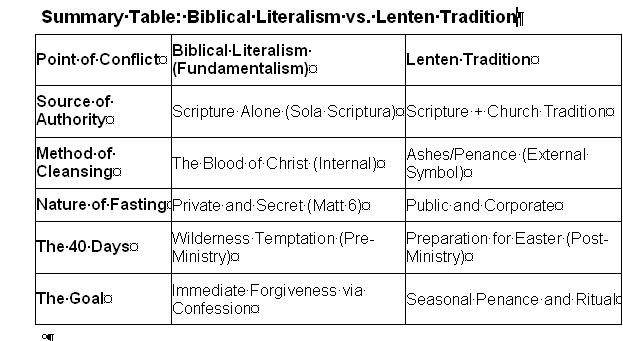
Final Assessment
- Your insights regarding the Red Heifer
are particularly sharp from a typological perspective. To use
ashes-which represent the remainder of a sacrifice that was burned-to
represent a Savior who was resurrected and whose body was preserved,
creates a symbolic contradiction.
From a Fundamentalist perspective, the "seismic revelation"
you described holds water: The Christian is a "new creation"
identified with the Risen Christ, not a mourner identified
with the ashes of a heifer.
. (2.24.2026 - Author Christian Wei - drwei@eucon.edu)
- Disclaimer: The views expressed
in this article are the sole responsibility of the author. If
you have a problem with the correctness of the information, please
contact the author.
- (In accordance with Title
17 U.S.C. Section 107, this material is distributed without profit
to those who have expressed a prior interest in receiving the
included information for research and educational purposes.)
- Tell your friends about
us and thank you for visiting Cephas Ministries http://www.go-cephas.com
|